

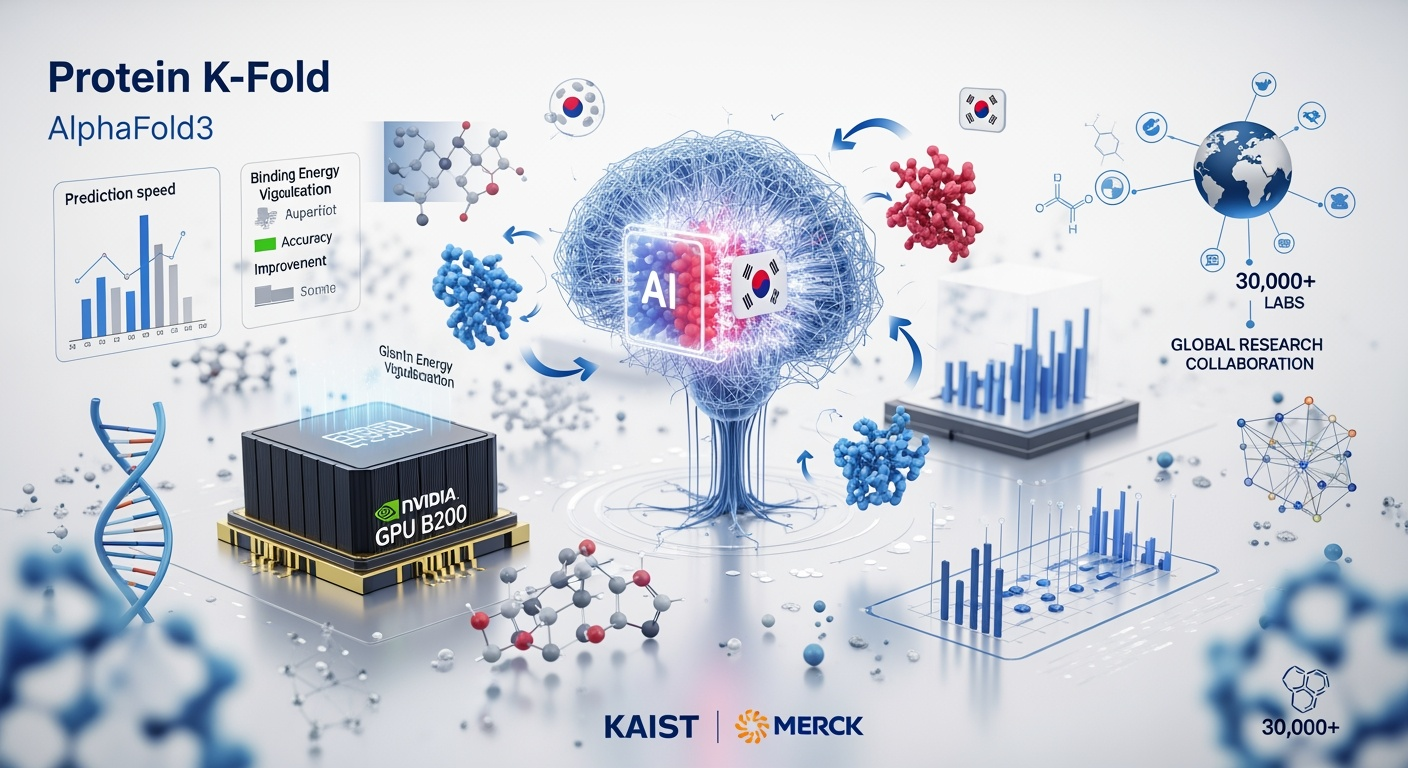
While Google DeepMind's AlphaFold3 achieved groundbreaking results in protein structure prediction, existing methods, which rely solely on data statistics, have shown fundamental limitations in accuracy and speed. To overcome these, KAIST is developing the 'K-Fold' model, which autonomously learns the principles of physical and chemical interactions within proteins. This technology can accurately predict protein dynamics, including how proteins change into various forms, and the strength of intermolecular bonds. Unlike conventional AI that merely provides 'correct answers,' K-Fold is a next-generation model that understands 'why' these phenomena occur. KAIST has formed 'Team KAIST,' with Professor Woo Youn Kim of the Department of Chemistry as the general director, Professors Sung-Ju Hwang and Sungsoo Ahn of the Graduate School of AI leading core model development, and Professors Byung-Ha Oh, Ho Min Kim, and Kyu-Ri Lee of the Department of Biological Sciences responsible for data validation. The team plans to complete development and commercialization by September 2026, supported by 256 state-of-the-art NVIDIA B200 GPUs. Notably, global life science company Merck has pledged to integrate K-Fold into its digital experimentation platform, making it accessible to over 30,000 laboratories worldwide. The developed technology will be open-sourced under the Apache 2.0 license, allowing free use by anyone. The Korea Bio Association and the Korea Pharmaceutical and Bio-Pharma Manufacturers Association will promote K-Fold-based education and AI talent development programs for their approximately 850 member companies. This initiative is more than just technology development; it is a national strategic project aimed at accelerating the AI transformation of the entire Korean bio and pharmaceutical industry, and it is expected to be a crucial stepping stone for Korea to secure technological sovereignty in the global new drug development competition.