

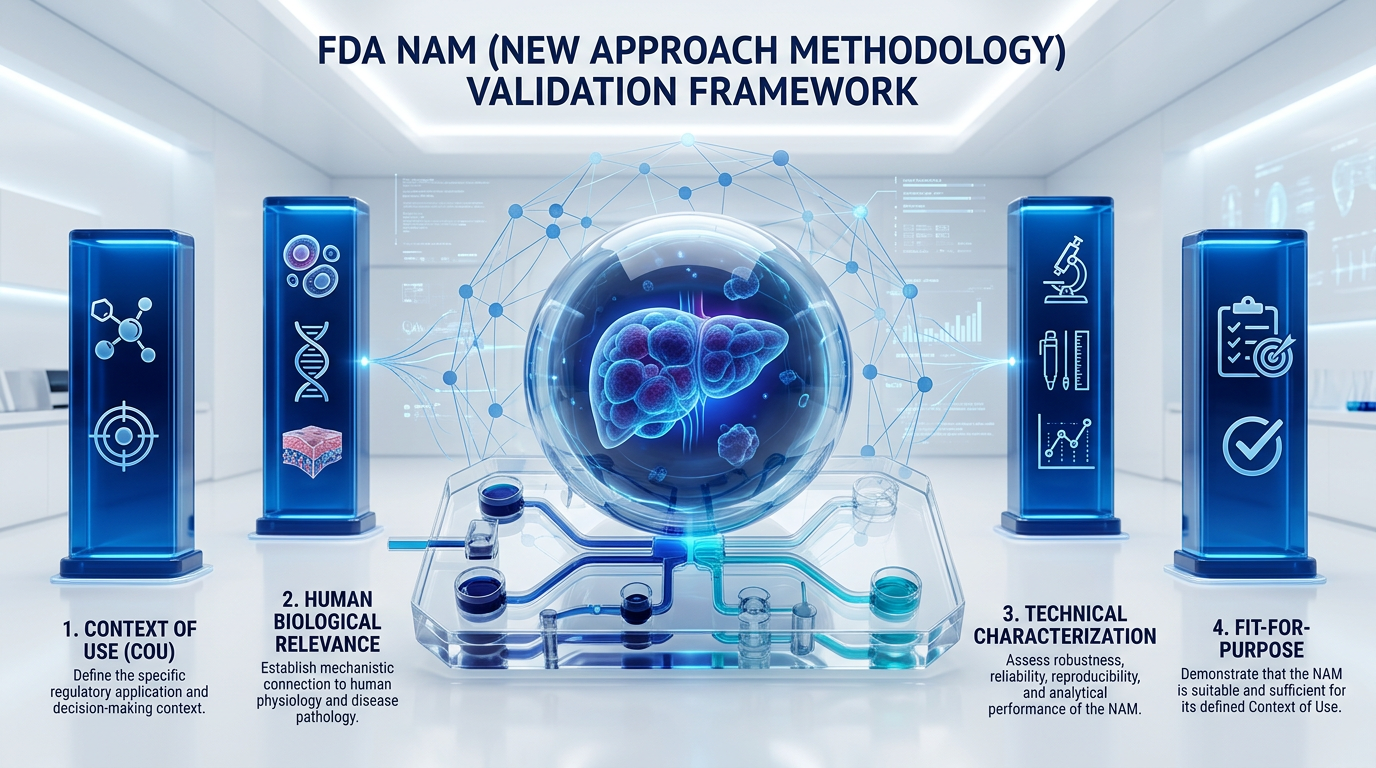
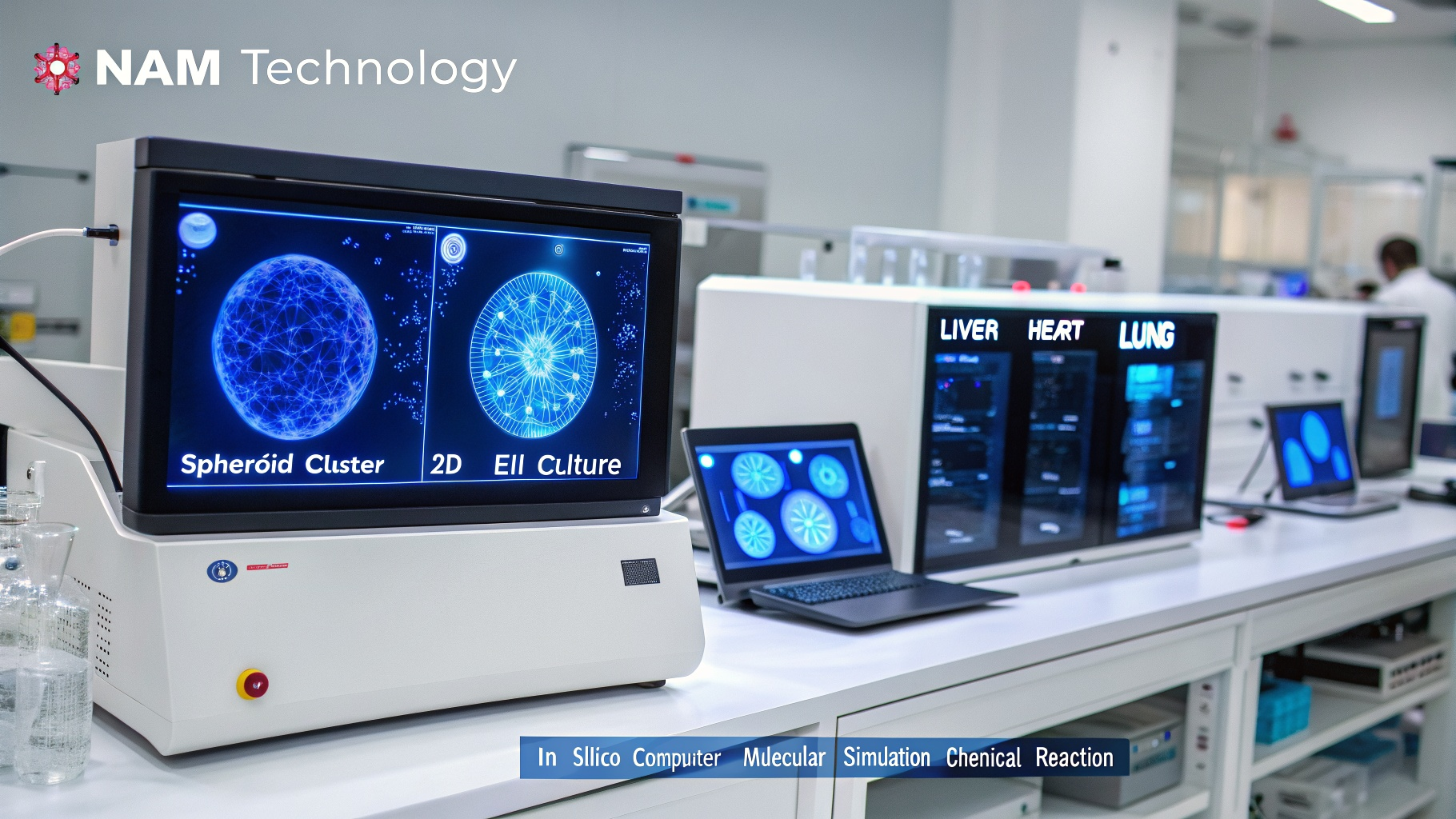
① What are NAMs? — Six Recognized Technologies New Approach Methodologies (NAMs) is a collective term for all non-animal testing methods designed to replace, reduce, or refine traditional animal testing. In this guidance, the FDA officially recognized the following six technologies: Technology Category Key Features Organoid Complex in vitro Stem cell-based 3D mini-organs, patient-specific toxicity prediction Spheroid Complex in vitro 3D cell aggregates, recapitulating the tumor microenvironment Organ-on-a-Chip Complex in vitro Microfluidic technology to reproduce blood flow and mechanical stimuli 2D Cell Culture Simple in vitro Traditional planar cell culture, high-throughput screening In silico Computer simulation AI/ML-based toxicity and pharmacokinetic prediction In chemico Chemical reaction-based Toxicity assessment via chemical reactions without cells Notably, following the enactment of the FDA Modernization Act 2.0 in 2022, which removed the requirement for animal testing in drug approval, this guidance officially incorporates alternative testing methods into actual regulatory decision-making processes. ② Four Validation Principles — What the FDA Requires The FDA has presented **four validation principles (Validation Framework)** for NAM data to be accepted as regulatory submission material. 🔵 Principle 1 | Context of Use (COU) — Defining the Context of Use "What scientific question does this NAM answer for what regulatory purpose?" Before using a NAM, it is essential to clearly specify ▲the scientific question to be addressed ▲the regulatory purpose (e.g., IND submission, dose selection, toxicity prediction) ▲whether it is for standalone use or supportive evidence. The guidance emphasizes that a single NAM does not need to prove everything, and clearly defining the scope of use is key. 🔵 Principle 2 | Human Biological Relevance — Human Biological Relevance "How faithfully does this system reproduce actual human physiology?" It must be demonstrated that information generated from NAMs impacts toxicity prediction that cannot be measured in actual human clinical settings. This involves verifying human cell types and tissue sources, human-specific metabolic pathways and receptor expression, and the ability to reproduce human physiology-specific responses. The core message is: **"Prove that the data is more directly applicable to humans than animal data."** 🔵 Principle 3 | Technical Characterization — Technical Characterization "How was this NAM created, and how is it measured?" Mandatory documentation items: Dose/concentration and exposure duration Statistical analysis methods and sample size Sensitivity, Specificity, and Reproducibility Cell/tissue source and batch-to-batch variability Scientific reproducibility and data reliability are key review criteria. 🔵 Principle 4 | Fit-for-Purpose — Demonstrating Fit-for-Purpose "Does this NAM provide information equivalent to or superior to traditional testing methods?" It must be demonstrated whether the NAM can fill data gaps not provided by existing animal testing, and prove equivalent or superior predictive power compared to existing methods. Importantly, full validation is not always required — NAMs with demonstrated fit-for-purpose within a Weight of Evidence (WoE) approach are also permitted. ③ Regulatory Scope of NAM Data Utilization — How Far Can It Be Used? Application Area Specific Examples IND (Investigational New Drug) Submission Replacement for non-clinical toxicity data BLA (Biologics License Application) Non-clinical evidence for biosimilars Clinical Dose Selection First-in-human (FIH) and later stages Adverse Event Mechanism Elucidation Understanding toxicity mechanisms WoE Risk Assessment Integrated support for weight of evidence approach 💡 Key Implication: NAM data is now recognized as official IND submission material. In 2025, the FDA already approved the first IND based solely on human organoid efficacy data. ④ Global Market Outlook — A 44 Trillion Won Market Opens According to global market research firm Market Research Future, the global animal alternative testing market is projected to expand to approximately $29.4 billion (about 44 trillion Korean Won) by 2030. Within this, the key human organoid market is expected to grow at a high CAGR of 18.8% from approximately $1.44 billion (about 2.1664 trillion Korean Won) in 2026 to approximately $5.71 billion (about 8.5906 trillion Korean Won) by 2034. ┌───────────────────────────────────────────────────┐ │ Animal Alternative Testing Market Size Forecast │ │ │ │ 2024 ────── $3.5 billion │ │ 2026 ────── $5.2 billion (estimated, +22%) │ │ 2030 ────── $29.4 billion (approx. 44 trillion KRW) │ │ 2034 ────── $30 billion+ (organoids alone $5.7 billion) │ └───────────────────────────────────────────────────┘ ⑤ Analysis of Benefits for Korean Companies Company Key Technology FDA NAM Relevance Expected Benefits Samsung Biologics Organoid screening platform Direct beneficiary, CDMO→CRO expansion Seizing the 44 trillion KRW market, lock-in effect JW Pharmaceutical Collaboration with Organoid Science Non-clinical translational research platform Reduced clinical-non-clinical discrepancies Organoid Science Patient-derived organoids IND data supply Accelerated commercialization by 2027 Mepsgen Human organ-on-a-chip Securing organ-on-a-chip regulatory pathway Global partnership opportunities Nexel Human cardiomyocytes and hepatocytes Utilization of 2D/3D in vitro Increased demand for toxicity assessment - Refer to attached files - 63838574dft_general_considerations_for_the_use_of_new_approach_methodologies_in_drug_development.pdf 285KB