

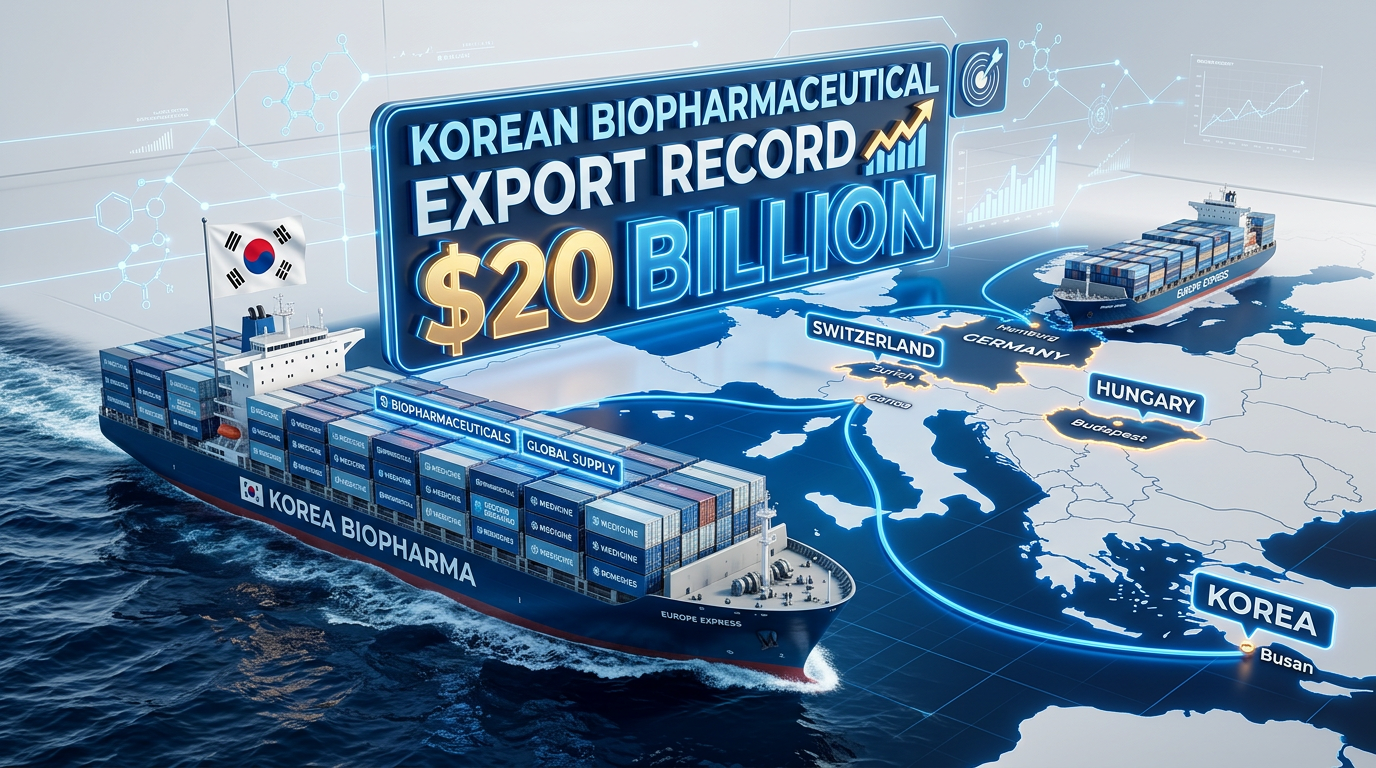
According to the Ministry of Food and Drug Safety (MFDS), South Korea's bio-pharmaceutical exports in the first quarter of 2026 reached $2 billion (approximately 2.9 trillion won), setting a new all-time high for Q1. This represents an 11.1% increase compared to the same period last year, with bio-pharmaceuticals accounting for 71% of total pharmaceutical exports. Q1 export figures have shown a steady upward trend, reaching $1.5 billion in 2024, $1.8 billion in 2025, and $2 billion in 2026. This achievement, amidst global economic slowdown, high exchange rates, and geopolitical risks stemming from the Middle East, suggests that the industry has entered a structural growth trajectory. The bio-health industry as a whole recorded Q1 exports of $4.16 billion (approximately 6.3 trillion won). By country, Switzerland emerged as the top export destination with $340 million, followed by the United States at $330 million, and Hungary at $300 million. Notably, exports to Switzerland surged by 70% year-on-year, showing the steepest growth. Europe is one of the fastest-adopting markets for biosimilars globally, with precedents where anti-cancer biosimilars like bevacizumab and trastuzumab achieved over 80% market share within three years of introduction. This indicates a structure where large CDMO infrastructures, such as Samsung Biologics, Celltrion, and Lotte Biologics, are driving not only finished product exports but also production service exports. However, there are concerns about high reliance on specific markets, as the top five export countries account for over 68% of the total. There is also a consistent call to increase the proportion of innovative new drugs, moving beyond growth centered on biosimilars and CDMOs. An industry official stated, "This record export performance is a symbolic achievement that solidifies K-Bio's position as a key player in the global supply chain," adding, "Securing proprietary new drugs and platform technologies will determine the next phase of growth." The MFDS is also continuously expanding the export base by reducing GMP data submission requirements, simplifying approval and review processes, and enacting special legislation for CDMOs.