

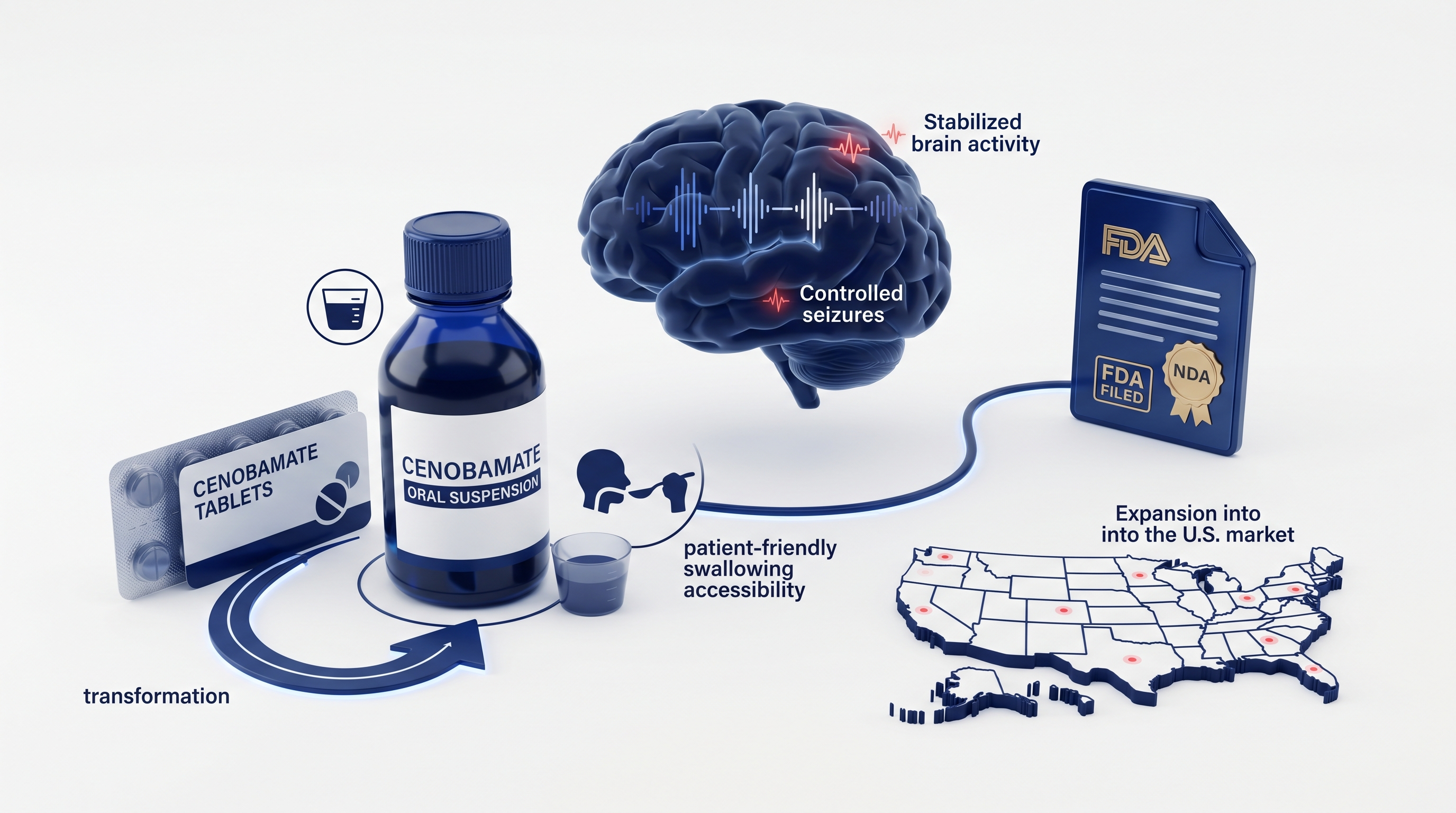
SK Biopharmaceuticals has submitted a New Drug Application (NDA) to the U.S. Food and Drug Administration (FDA) for an oral suspension formulation of cenobamate, its epilepsy treatment. This application aims to add a new administration option to the tablet formulation already on the market, targeting adult patients with partial-onset seizures. The core strategy is not to change the drug itself, but to broaden the ways in which patients can actually take it. This clearly demonstrates a strategy to expand the prescription base by extending a successful new drug to a wider patient population. The newly applied-for oral suspension can be a much more practical choice for patients who have difficulty swallowing tablets. As a liquid form, it offers high convenience of administration and the advantage of more flexible dosing depending on the patient's condition or treatment environment. Ultimately, if the barrier to administration is lowered for the same active ingredient, the likelihood of it being chosen in actual clinical practice significantly increases. Since patient adherence is as crucial as efficacy in epilepsy treatment, expanding the formulation is not merely adding an option but directly linked to broadening the revenue base. This move is noteworthy for the market as it represents a way to ensure that “a well-developed drug is taken by more patients, from start to finish.” SK Biopharmaceuticals is not stopping there; it is also concurrently developing cenobamate for pediatric patients. This paints a picture of expanding a single blockbuster candidate from tablets to liquid, and from adults to a broader patient population. As the real competition after new drug development often lies in expanding indications and diversifying formulations, this FDA application is seen as a subsequent step to further grow the cenobamate business. The U.S. market has a wide patient base, and prescription data directly translates into corporate value. For SK Biopharmaceuticals, this application is not just a simple formulation addition but a practical move to solidify its presence in the U.S.