

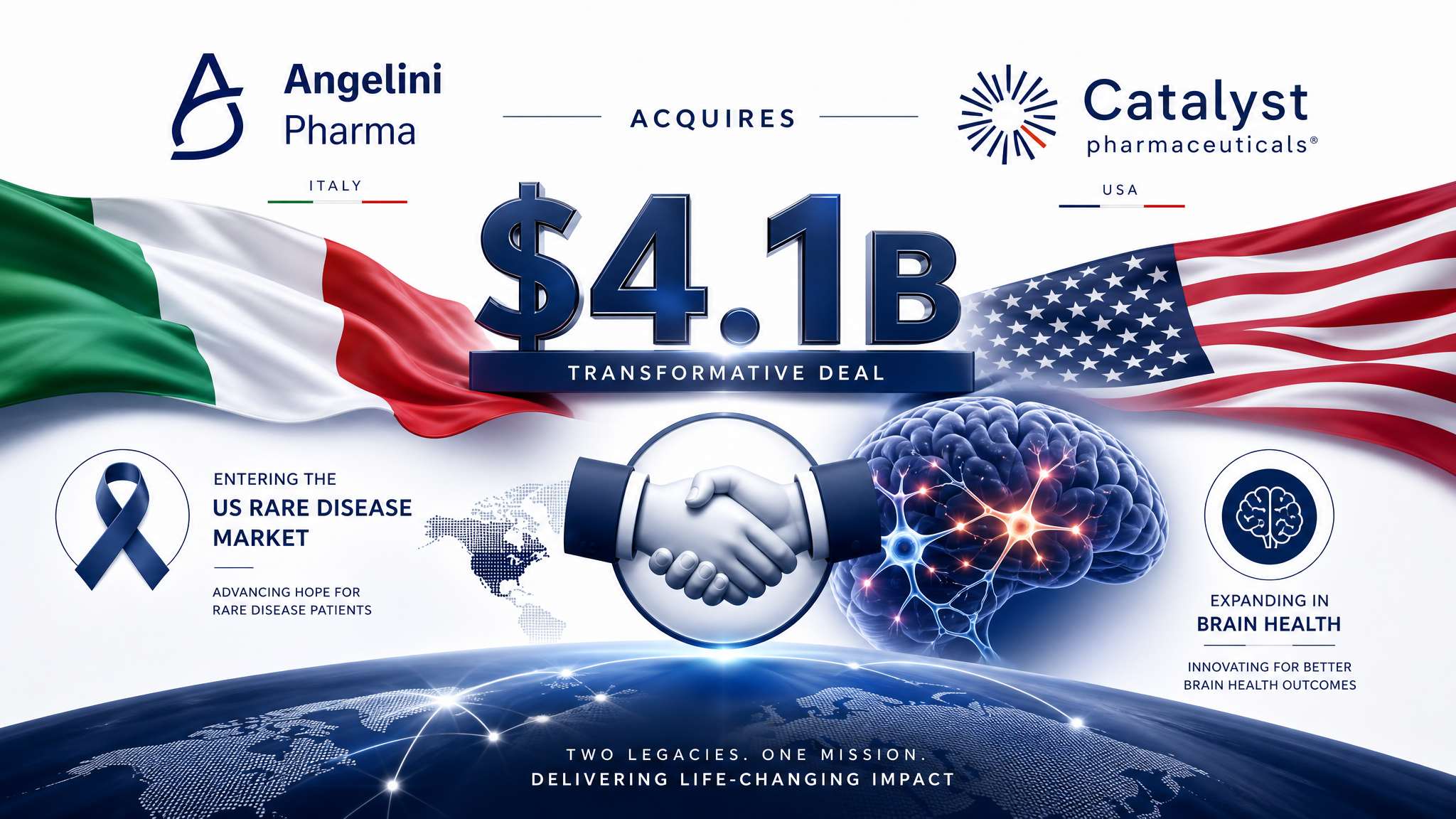
On May 7, Italian Angelini Pharma announced its acquisition of US rare disease specialist Catalyst Pharmaceuticals for $4.1 billion (approximately 5.6 trillion won). Catalyst, a rare disease company, possesses Firdapse, a treatment for Lambert-Eaton Myasthenic Syndrome. This transaction marks the largest-ever M&A for an Italian pharmaceutical company entering the US market. The deal is expected to close in the third quarter of 2026, having been unanimously approved by both companies' boards of directors. Through this acquisition, Angelini will gain immediate entry into the US market and secure a portfolio of neurological rare diseases. This transaction should be viewed within the broader context of “brain health + rare diseases.” Following Sun Pharma's $11.75 billion acquisition of Organon on April 27, another global M&A deal worth $4.1 billion emerged in the second week of May. This signals that global Big Pharmas are stepping back from the GLP-1 and oncology race, redirecting capital towards “high-margin, high-barrier-to-entry areas” such as rare diseases, neurology, and autoimmunity. For Korean companies with rare disease pipelines, such as GC Cell, Medipost, and Rznomics, this trend is not merely international news but could potentially set a benchmark for future licensing and M&A valuations. Delving deeper, this major deal also indicates that the cost of entering the US market is rising again. With the US Trump administration simultaneously imposing drug tariffs and price pressures, global pharmaceutical companies are attempting to circumvent tariff and pricing risks by “acquiring companies with existing US revenue streams.” Angelini's $4.1 billion acquisition of Catalyst, a company with an established US revenue pipeline, is in the same vein. For Korean companies, this trend offers two implications: First, Korean biopharmaceutical companies with a certain level of US revenue are likely to become priority candidates for global M&A. Second, companies without such revenue should consider a strategy of “joint development and commercialization with existing US companies” rather than direct US market entry. In essence, this transaction more clearly illustrates the crossroads for Korean biotech, distinguishing between companies that will be acquired and those that will remain independent.