

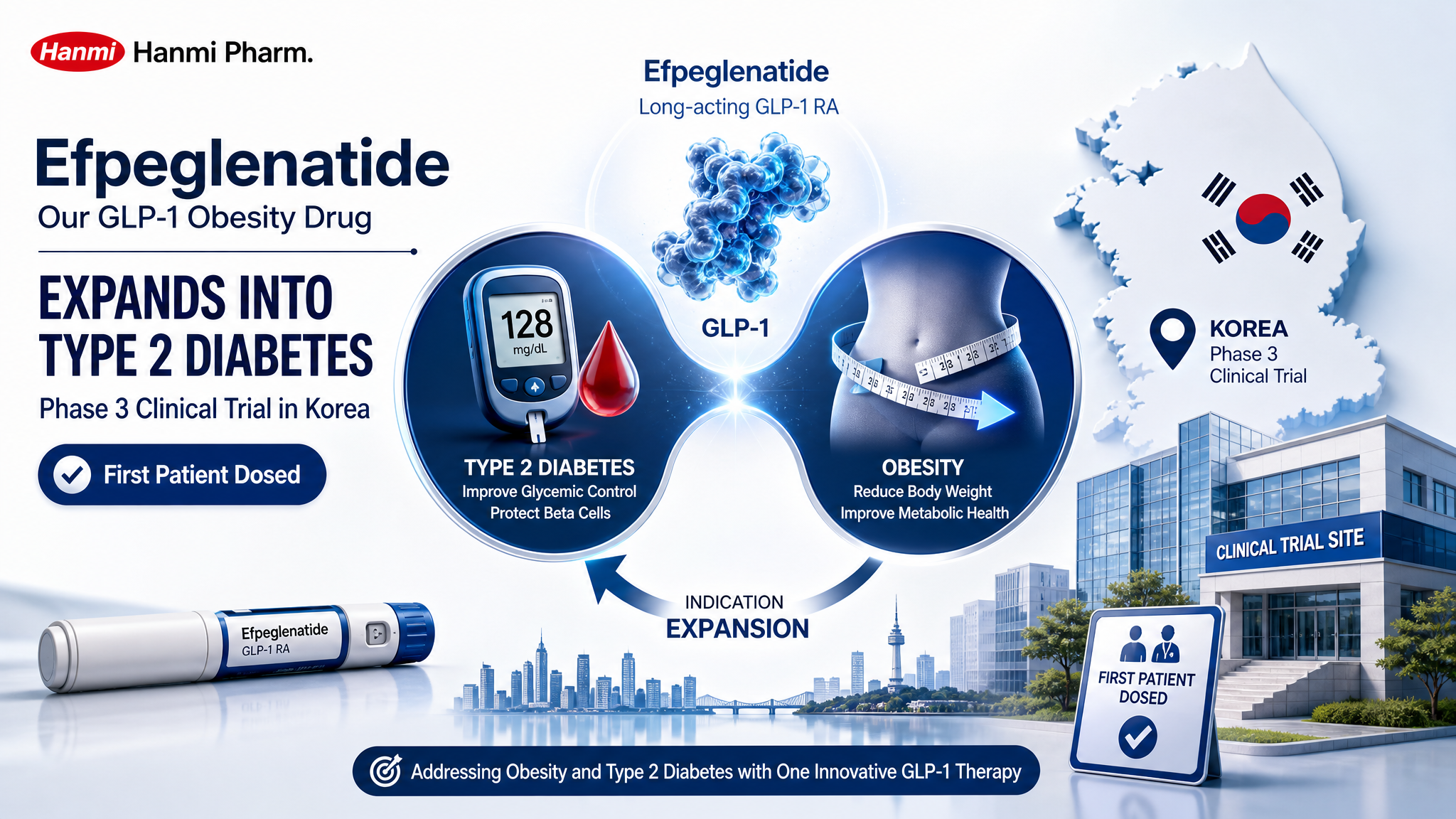
Hanmi Pharmaceutical announced that 'Epeglenatide,' a GLP-1 new drug developed with its proprietary technology, was administered to the first patient in a domestic Phase 3 clinical trial for type 2 diabetes on May 18. This trial is a multi-center, randomized, double-blind study designed to evaluate the glycemic control efficacy and safety of adding Epeglenatide compared to a placebo in patients whose blood sugar is not adequately controlled with metformin + dapagliflozin. The Ministry of Food and Drug Safety approved this clinical trial on January 21 of this year, with an expected completion date in 2028. The key takeaway is that while preparing for market approval for the obesity indication within the year, the company has also begun to validate the same drug for diabetes. This trial represents Hanmi's attempt to redefine Epeglenatide from an “obesity drug” to an “integrated metabolic disease treatment.” The company has already accumulated data from approximately 6,000 type 2 diabetes patients with global partners, and its potential for cardiovascular and renal protection has been published in NEJM and Circulation. This Phase 3 triple-combination trial is akin to a precise re-validation of that data tailored for the Korean market. The company's perspective that obesity is not a single disease but a “complex metabolic disease” connected to diabetes, cardiovascular, and renal diseases is directly reflected in the clinical design. Delving deeper, this trial signals that Hanmi's Lifecycle Management (LCM) strategy has truly begun to operate. Alongside indication expansion, diversification of formulations such as auto-injectors and pre-filled syringes, and integration with digital therapeutics (DTx) models are all encompassed within the LCM strategy. If this trend solidifies, Epeglenatide could aim for a position closer to a “Korean version of Mounjaro + dapagliflozin combination package” rather than a “Korean version of Wegovy.” At a time when the GLP-1 competition among global big pharma is shifting from “single vs. single” to “platform vs. platform,” the results of this Phase 3 trial are not merely an addition of an indication but will redefine Hanmi's global licensing negotiation power itself. Considering that the U.S. Supreme Court solidified the constitutionality of Medicare drug price negotiation laws in the same week, it is also a favorable development for Hanmi that companies expanding their indications to grow their “patient pool” will be most advantageous under price pressure.