

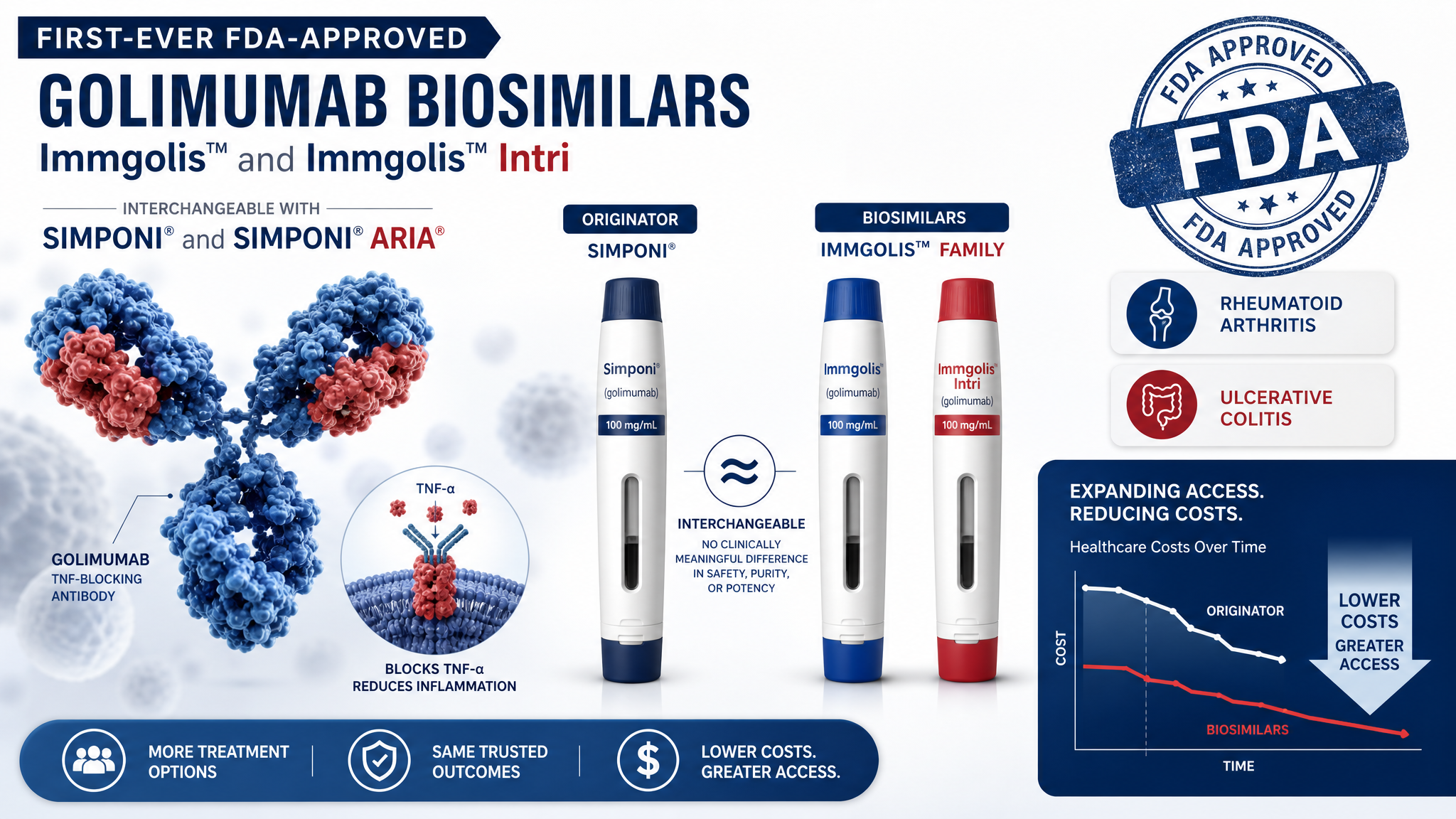
On May 15, the U.S. FDA simultaneously approved 'Immgolis (golimumab-sldi)' and 'Immgolis Intri,' the first biosimilars for golimumab (Simponi·Simponi Aria). They have also received interchangeable status with the original drug, with indications covering autoimmune conditions such as rheumatoid arthritis and ulcerative colitis. Accord BioPharma will exclusively handle U.S. commercialization, with both companies targeting a late 2026 launch. Golimumab has been one of the last major TNF blockers without a biosimilar, and this approval will now bring significant price reduction pressure to the entire U.S. TNF market. The first implication of this approval is that "the last gap in TNF biosimilars for the autoimmune sector has been filled." With biosimilars now entering the market for Simponi, following Humira, Enbrel, and Remicade, the global autoimmune market's price curve is set to decline further. For U.S. insurers, the fact that it is an "interchangeable biosimilar available for outpatient prescription" is crucial. Pharmacists can directly substitute it at the pharmacy level, creating a structure where patients can naturally switch to the biosimilar in the outpatient market without doctors needing to change prescriptions. Delving deeper, this approval sends a clear signal to Korean biosimilar companies. Celltrion has already established itself in the U.S. autoimmune market with Zymfentra (Remsima SC), and Samsung Bioepis is strengthening its high-concentration Hadlima (Humira biosimilar) lineup. As Immgolis begins to penetrate the golimumab market, decisions by Celltrion and Samsung Bioepis regarding the pricing and distribution channels for their next-generation TNF and IL biosimilars will be directly impacted. Furthermore, if the current deal structure of "developer (e.g., Alvotech/Intas) + U.S. commercialization partner (Accord BioPharma)" becomes solidified, Korean biosimilar companies are likely to prioritize securing U.S. commercialization partners over entering the market independently. When viewed in conjunction with the U.S. Supreme Court's decision upholding Medicare drug price negotiations in the same week, the U.S. market is now rapidly bifurcating into "high-priced novel drugs vs. low-priced biosimilars," which is clearly a favorable trend for Korean biosimilar companies.