

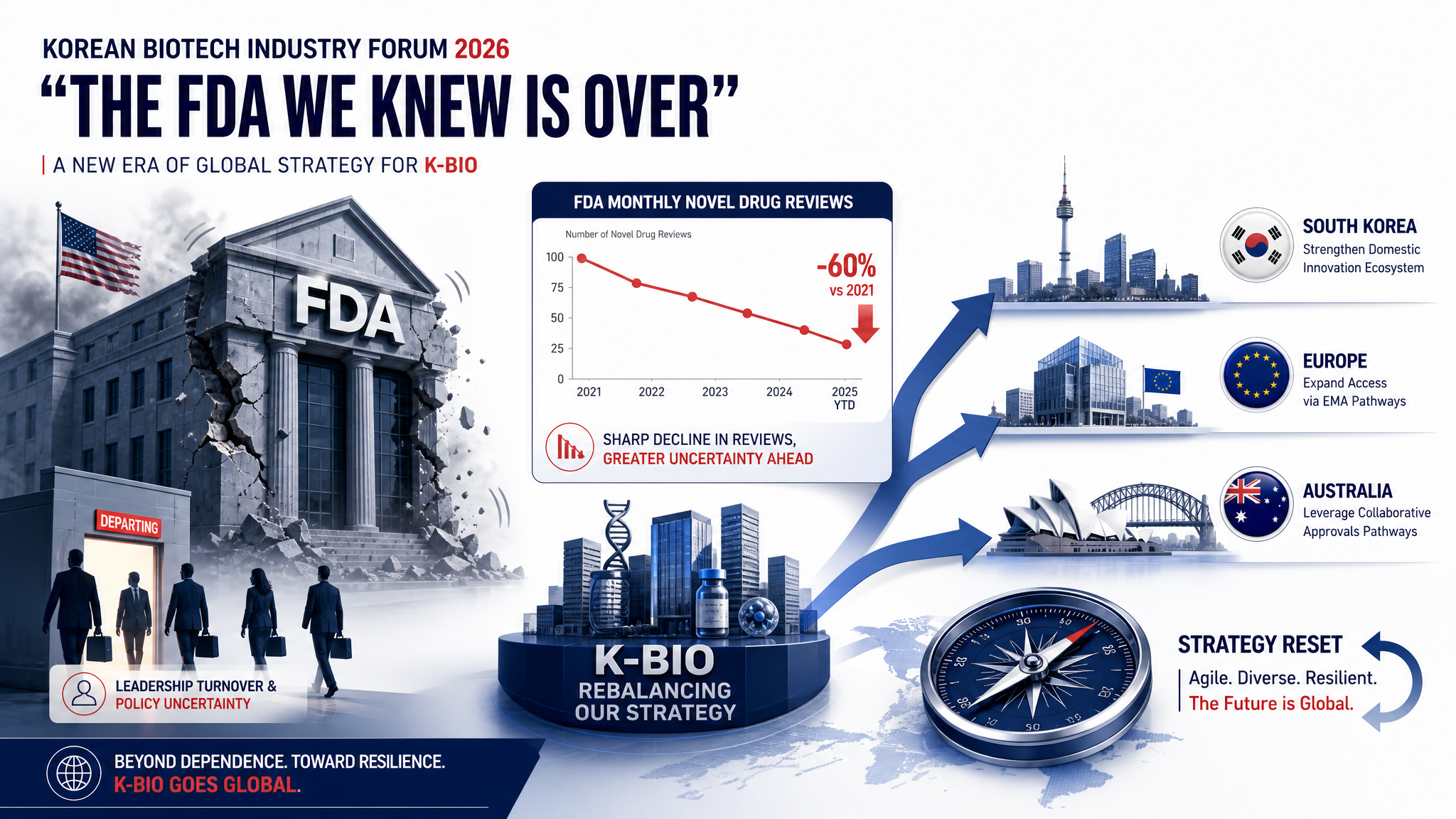
At the '2026 HLB Forum' held on May 12th at Sofitel Ambassador Seoul in Songpa-gu, Seoul, Jeong Sang-mok, CEO of Naturecell, publicly declared, "The FDA we knew is over." He conveyed that over the past year, the FDA has experienced instability across its organization, policies, and procedures. For new drug developers, the magnitude of these changes has moved beyond a 'risk' phase to become a 'strategic variable.' In line with this trend, Health Korea News reported that the FDA's review of new drugs (Novel Drugs) in May was limited to a single case ('CTx-1301'). Even when including supplemental New Drug Applications (sNDA), the total number of reviews was significantly lower than in previous years. For K-bio, this signals that the formula of "just submit to the FDA, and time will resolve it" is no longer valid. A key focus of the forum was the "FDA's leadership and personnel exodus." When core personnel leave review departments, the depth and speed of review for the same IND or NDA can change. Reuters also reported that some US biotechs have begun moving early clinical stages outside the US. Given K-bio's high reliance on US clinical trials, this trend poses a more direct burden. For Korean candidates like GI Innovation's GI-101A, which are set to be featured on the main stage at ASCO, a strategy of direct breakthrough with "data quality" has become more crucial. Conversely, companies in Phase 1 and 2 clinical trials have begun hedging by increasing the proportion of multinational clinical trials outside the US (in Korea, the EU, and Australia). Delving deeper, the true signal from this forum is that "regulatory hedging is capital hedging." With the convergence of the Trump administration's drug tariffs, the constitutional validation of Medicare drug price negotiations, and the FDA's personnel exodus, Korean companies must now design not only their US market entry schedules but also consider "US revenue generation" and "US production and clinical bases." Celltrion's proactive securing of a US plant, Samsung Biologics' acquisition of the Rockville plant, and Alteogen's establishment as a subcutaneous (SC) formulation partner for global big pharma all fit within this broader picture. In essence, this forum was less an "FDA crisis diagnosis" and more a call for a "strategic reset" for the entire K-bio sector. It is highly probable that from the next quarterly earnings season, how Korean companies incorporate "FDA scenario-based clinical and revenue plans" into their investor relations materials will effectively become a new evaluation criterion.