

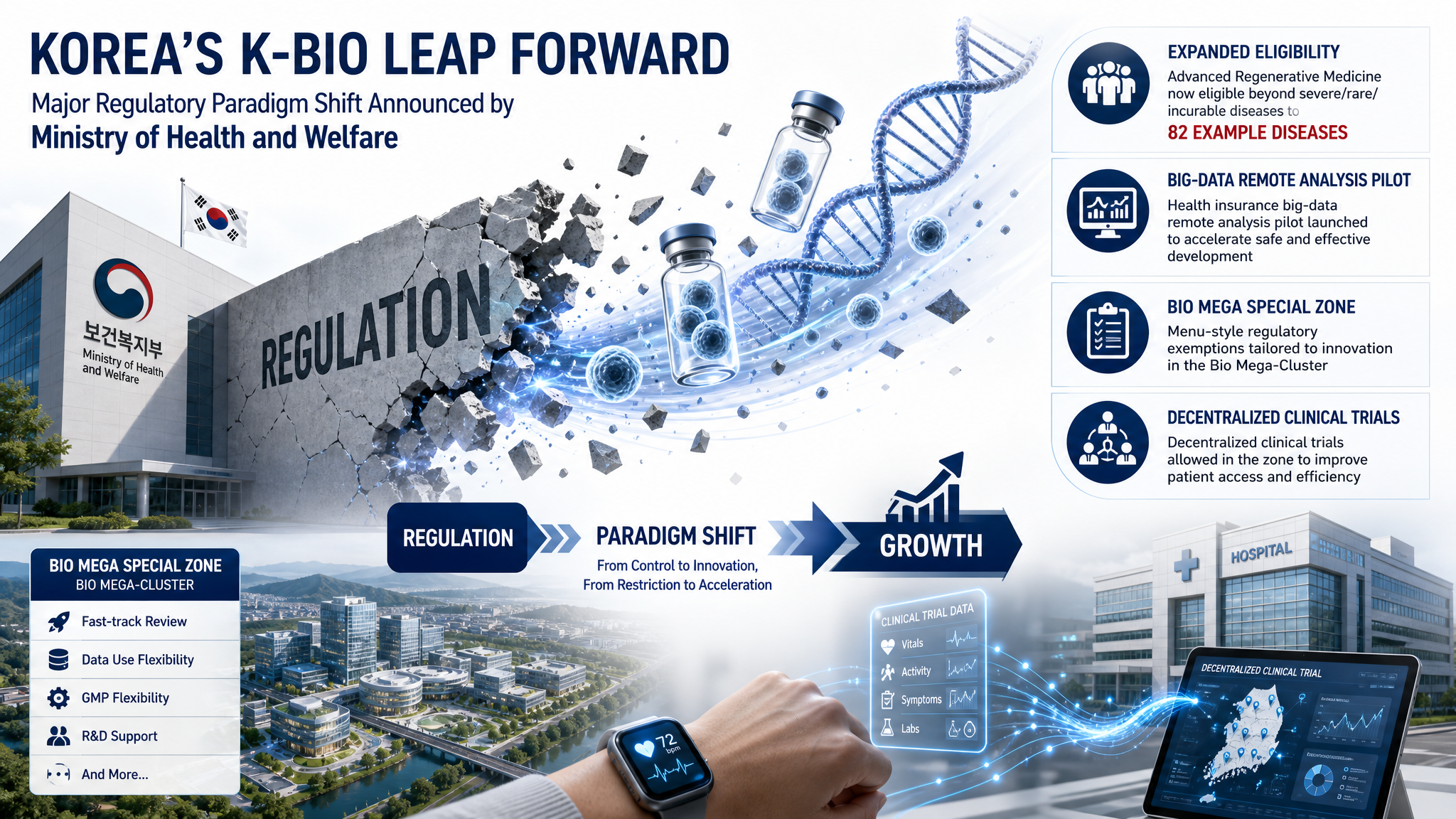
On June 1, the Ministry of Health and Welfare officially announced the reorganization of regulations that had hindered the growth of the K-Bio industry over the past year, shifting them towards a 'support and nurturing-centric' approach. The core of this initiative involves three key changes. First, the scope of advanced regenerative medicine, previously limited to severe, rare, and intractable diseases, will be expanded to include 82 example diseases. Second, standards for utilizing medical data of deceased individuals will be clarified, and a pilot project for 'remote analysis' of National Health Insurance big data will commence. Third, Bio Mega Special Zones, linked to the '5 Hubs, 3 Specialized Zones' balanced growth strategy, will be granted permission for decentralized clinical trials, a threefold relaxation of production facility area limits, and a 'menu-based' regulatory special exemption system. The government aims to achieve two goals simultaneously: expanding treatment opportunities for patients and revitalizing proactive corporate investment. The advanced regenerative medicine sector will see the most significant deregulation. Until now, even when stem cell treatment was medically feasible, indications were very narrowly defined, and even low-to-medium risk research required high-risk level non-clinical data. With this reorganization, autologous stem cell clinical research will become possible in Korea for areas that previously saw many patients seeking treatment abroad, such as chronic pain and musculoskeletal disorders. Furthermore, treatment utilizing verified overseas clinical data will be permitted even without domestic clinical results, and 'in vivo gene therapy' has been officially included in advanced regenerative medicine through the amendment to the Advanced Regenerative Bio Act, which passed the National Assembly on April 23. Cell processing facilities will also be allowed to 'import' human cell raw materials from overseas, creating a system where patients no longer need to travel to Japan, the United States, or Southeast Asia. The truly impactful changes lie within the Bio Mega Special Zones. For the first time, decentralized clinical trials will be permitted within these zones, allowing patient actions such as sending data via wearable devices from home or directly recording medication administration to be recognized as part of clinical procedures. The limit on production facilities within advanced medical complexes will be relaxed threefold, from 5,000㎡ to 15,000㎡, and the installation of production facilities for health functional foods and functional cosmetics, previously restricted, will now be allowed. Concurrently, 'local advanced regenerative bio deliberation committees' will operate separately, streamlining the process that was previously solely dependent on the central deliberation committee. Minister Jeong Eun-kyeong emphasized, “We will leap forward to become a global bio-health hub through bold, menu-based regulatory special exemptions.” This announcement is not merely a 'regulatory relaxation event,' but rather a comprehensive redesign of the clinical, production, and data aspects of the K-Bio industry.