

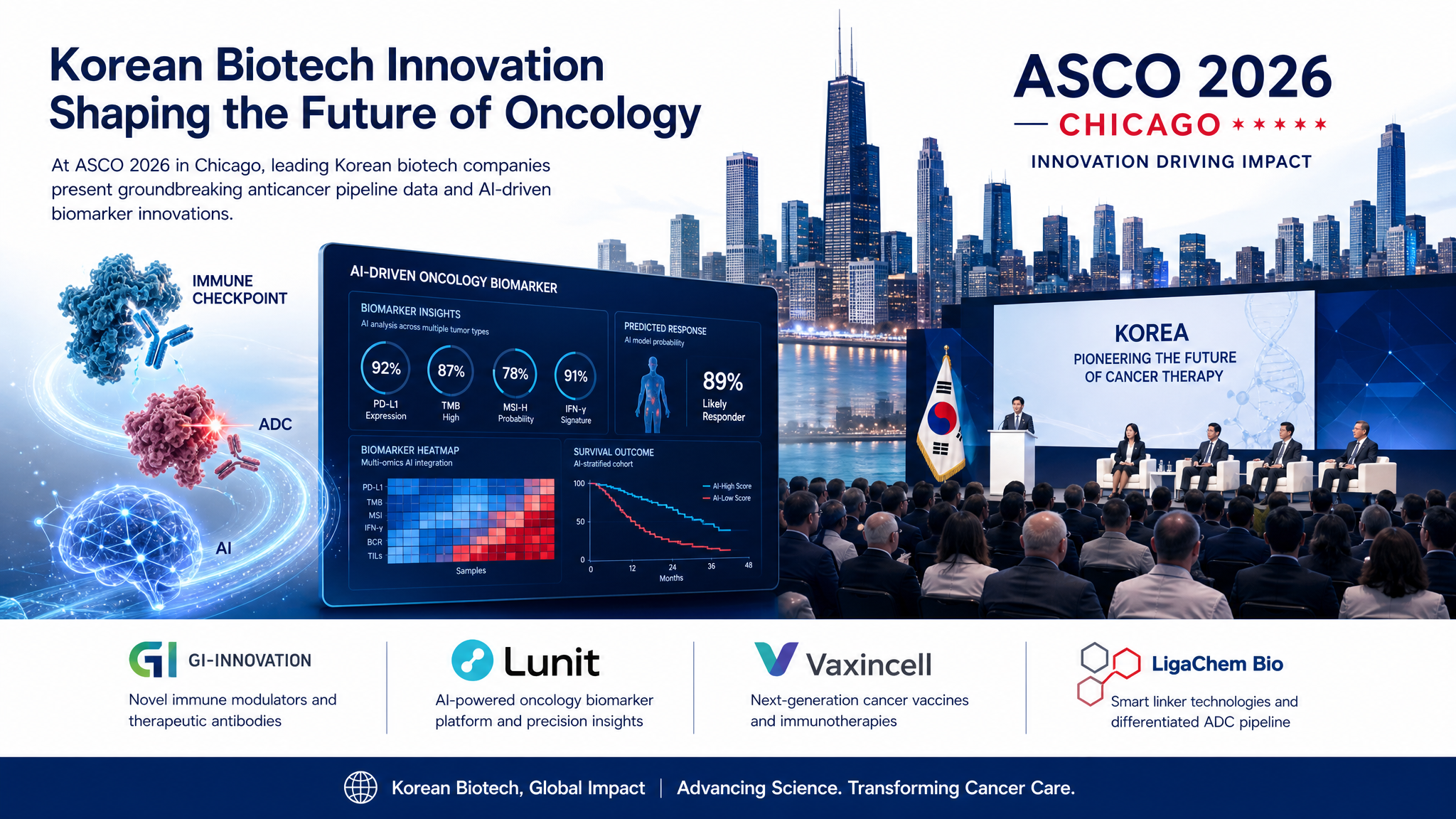
At ASCO 2026, which opened on May 30 in Chicago, USA, GI Innovation unveiled the abstract for its Phase 1/2 clinical trial of the immuno-oncology drug GI-101A, both as a monotherapy and in combination with Keytruda. The company stated that anti-cancer activity and tolerability were confirmed in both monotherapy and Keytruda combination therapy, and a clear trend of increased anti-cancer activity was observed with increasing dosage. An ASCO oral presentation is a prestigious platform where only top research abstracts from around the world are selected each year, making the inclusion of a Korean immuno-oncology drug a significant event in itself. Other K-Bio lineups also took the stage during the same period, including SillaJen's BAL0891, Vaxcell Bio's VT-EBV-N (the first official ASCO oral presentation for a domestic cell therapy), Onconic Therapeutics' Nesuparib, Lunit's SCOPE, and Oncocross's OC212e. This ASCO holds two simultaneous implications for K-Bio. First, it signals that “data quality creates value.” Previously, Korean anti-cancer new drugs garnered attention at AACR (focused on preclinical studies) but had a weak presence at ASCO (focused on clinical studies). The simultaneous inclusion of GI Innovation and Vaxcell Bio in the official ASCO oral presentation lineup signifies that Korean immuno-oncology and cell therapies have entered global standards on the “clinical stage.” Second, it concerns “re-evaluation of license-out prices.” If Keytruda combination data proves meaningful, big pharma is likely to fragment licensing not just as a single license but by region and indication, potentially leading to higher valuations. Delving deeper, ASCO 2026 is a potential “rebound trigger” for the entire K-Bio sector. While KOSDAQ has risen by +16%, the pharmaceutical and bio industry has fallen by -11%, and despite $6.5 billion in technology exports, stock prices remain below 2021 levels. At such a juncture, if ASCO data serves not as a one-off positive but as a “lineup-wide positive,” a full-scale re-evaluation of K-Bio in the second half of the year is highly probable. However, if the data falls short of expectations, not only GI-101A but also the multiples of other immuno-oncology candidates could be simultaneously affected, making this ASCO akin to a “comprehensive evaluation stage for all K-immuno-oncology drugs.”