

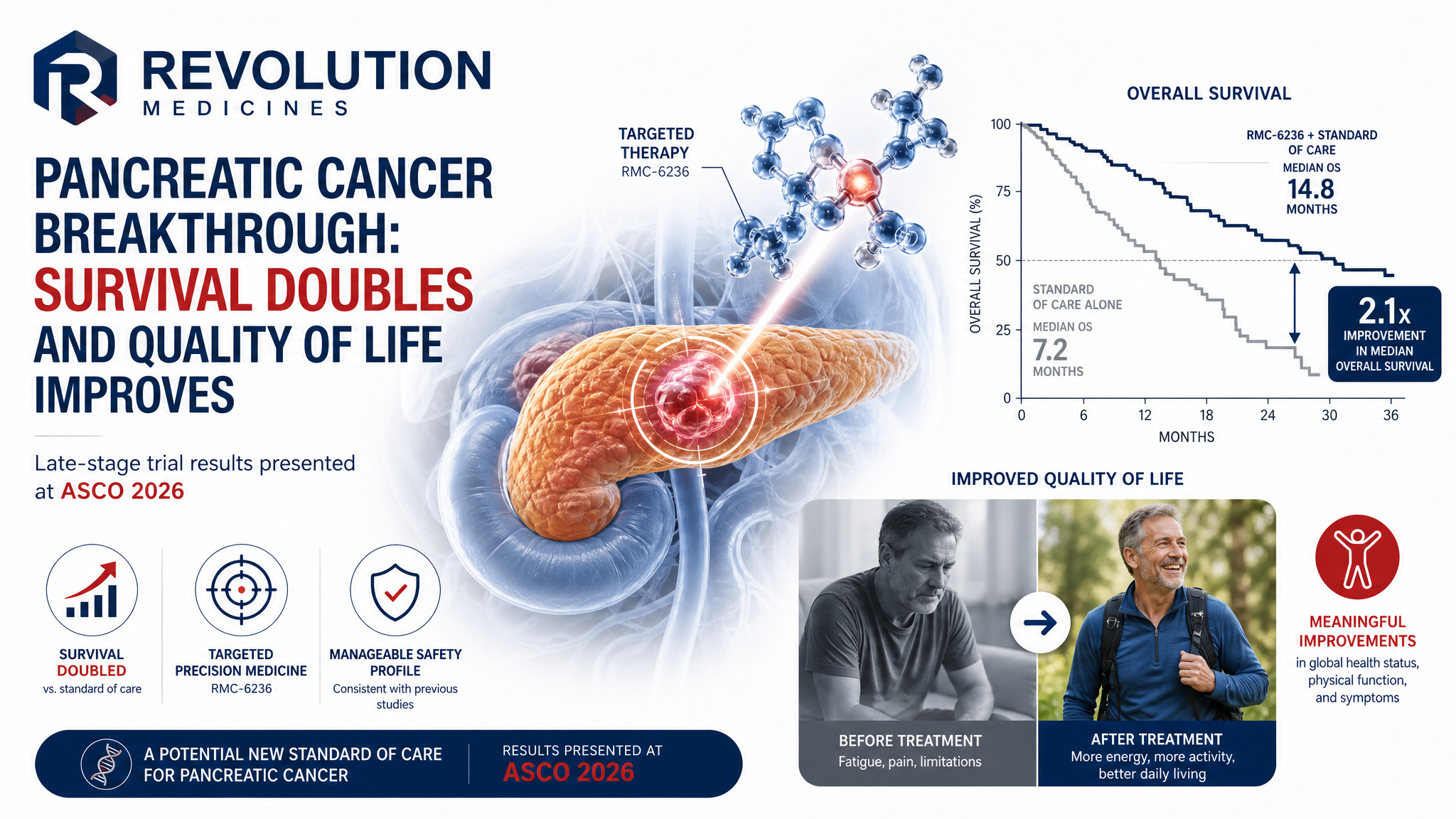
On May 31, at ASCO 2026, Revolution Medicines unveiled late-stage clinical trial results for its new pancreatic cancer drug, daraxonrasib, involving 500 patients. For patients with advanced pancreatic cancer who had failed first-line chemotherapy, the drug reduced the risk of death by 60% compared to standard chemotherapy, effectively doubling the median survival period from 6.7 months to 13.2 months. The rate of stopping or reducing tumor progression was 33.2% in the experimental group (G12 mutation group) versus 11.8% in the chemotherapy group. RAS mutations occur in up to 90% of pancreatic cancers, and daraxonrasib is a first-in-class “RAS(ON) inhibitor” that directly blocks RAS in its active state. The FDA had already granted expanded access to this drug on May 1, signaling an expedited review. The significance of these results extends beyond just “one new drug.” Pancreatic cancer has the highest mortality rate among all major cancers, with approximately 68,000 people diagnosed and 53,000 dying annually in the U.S. alone. The five-year survival rate for advanced/metastatic stages is around 3%, making it an area where no new drug has ever delivered results like “doubled survival.” Dr. Brian Wolpin, the principal investigator for the trial, stated, “This data will change how scientists, clinicians, and patients view pancreatic cancer treatment.” While rash (86.3%) was the most common side effect, the discontinuation rate was 1.2%, significantly lower than the 11.2% for chemotherapy. Delving deeper, the emergence of daraxonrasib fundamentally shifts the landscape of KRAS-targeted therapies. Until now, the KRAS field has been dominated by “RAS(OFF)” inhibitors, such as Amgen’s sotorasib and BMS’s adagrasib, which bind to KRAS G12C in its inactive (OFF) state. Daraxonrasib directly binds to KRAS in its active (ON) state, allowing it to be effective across the entire G12 spectrum. This implies the potential for indication expansion to almost all solid tumors where RAS is a key driver, including lung and colorectal cancers, not just pancreatic cancer. When viewed alongside Novartis’s presentation of follow-up data for Pluvicto with an actinium-based radioligand new drug and Mineralys’s data for a new blood pressure drug for CKD patients at the same ASCO, this ASCO represents a stage where three new drug paradigms—target, biomarker, and delivery method—have evolved simultaneously. For domestic RAS/KRAS-targeted drug developers, this raises the bar for comparison while also presenting an opportunity as a “new, validated, massive market has opened up.”