

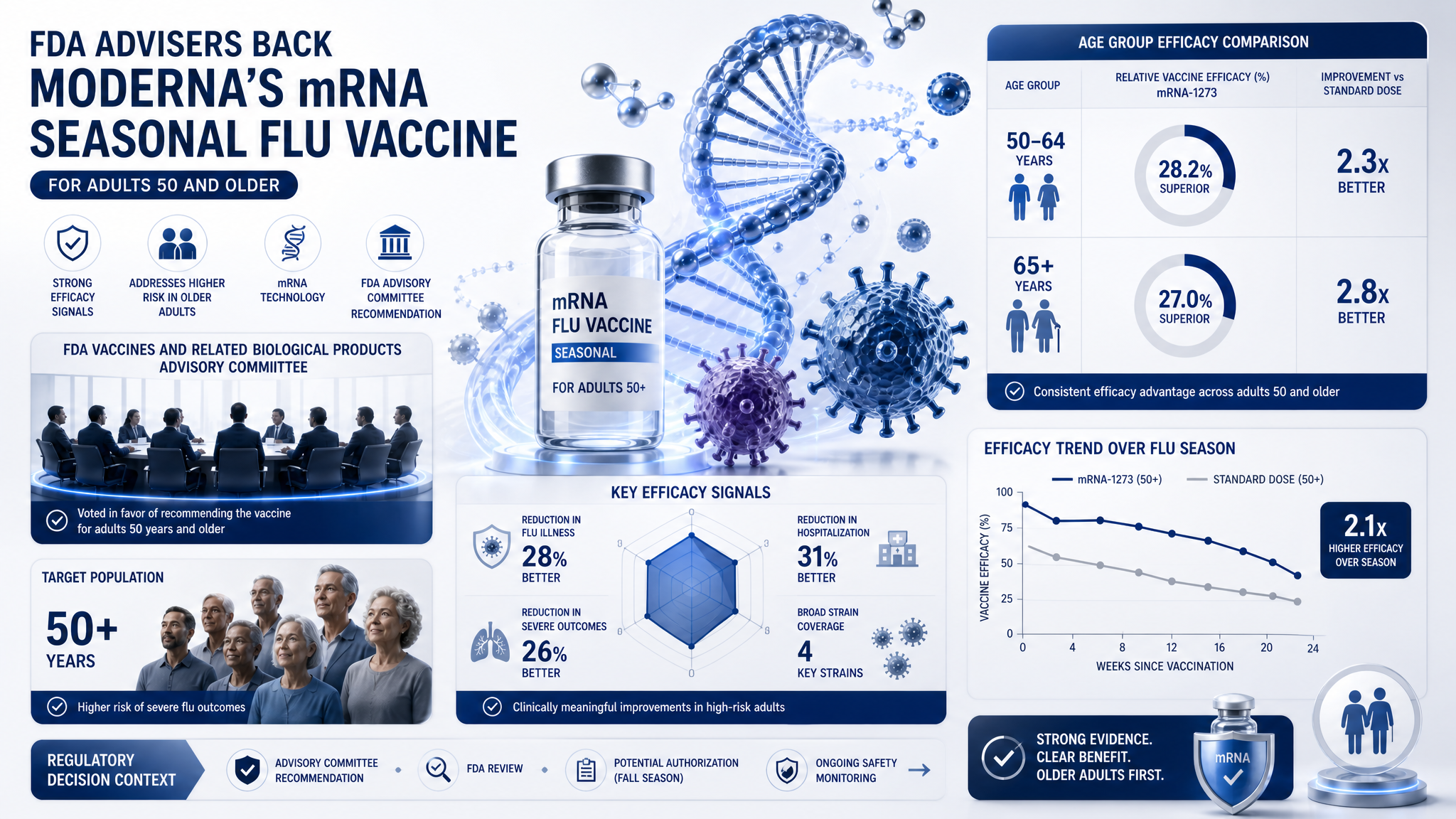
On June 18, the U.S. FDA Advisory Committee determined that the benefits of Moderna's seasonal flu vaccine, mRESVIA, outweigh the risks for adults aged 50 and older. All nine committee members voted in favor for both age groups (50-64 and 65+), significantly increasing the likelihood of Moderna launching the first mRNA-based seasonal flu vaccine in the U.S. According to Reuters, the FDA's final decision is expected by August 5. Given previous questions about the scalability of the mRNA platform after the COVID-19 vaccine, this news transcends a mere approval issue, signaling a re-evaluation of the platform itself. From a data perspective, this decision is also significant. Moderna stated that its flu vaccine demonstrated superiority over standard-dose flu vaccines in adults aged 50-64 and confirmed a strong immune response in the elderly population aged 65 and older. Advisory committee members are believed to have viewed positively not only the product's efficacy but also the advantage of mRNA technology in responding to future variants and preparing for pandemics. While traditional flu vaccines involve lengthy strain selection and production lead times, mRNA allows for faster updates. Therefore, this decision is not just news for Moderna but is also connected to a shift in the technological landscape of the entire vaccine industry. Of course, commercialization remains a challenge. Reuters reported that Moderna has already missed the U.S. flu vaccine contracting season for 2026, making significant revenue contributions unlikely until the second half of 2027. Nevertheless, this news is important because it can also raise expectations for other mRNA product lines, such as future COVID-flu combination vaccines. The market is currently focused more on resolving regulatory risks and platform scalability than on short-term figures. Frankly, this advisory committee's endorsement is more significant as a signal for the second act of mRNA commercialization than for a turnaround in Moderna's performance.