

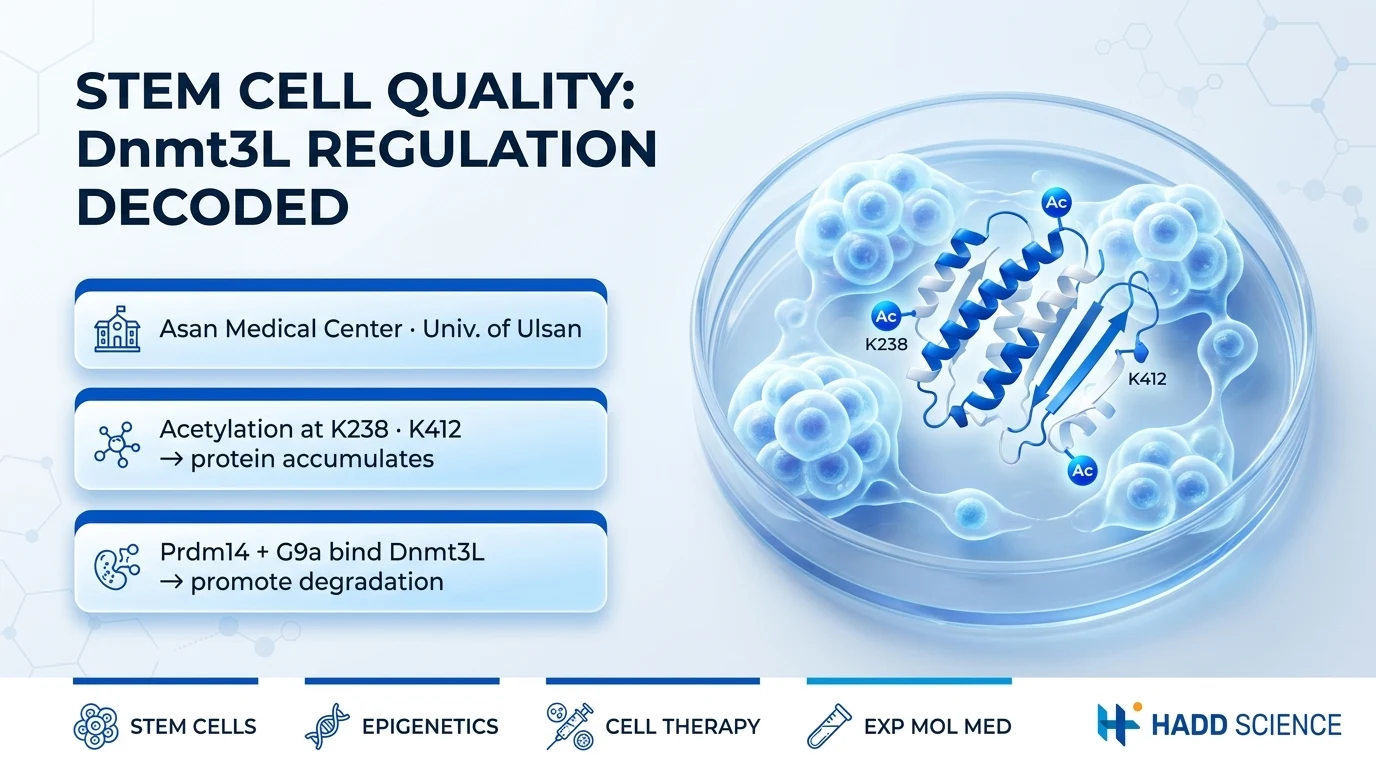
Mass culturing of stem cells has long faced the issue of declining cell quality. A research team at Asan Medical Center and the University of Ulsan College of Medicine has elucidated the regulatory mechanism of the key protein behind this phenomenon for the first time in the world. The protein in question is Dnmt3L. While it plays a critical role in maintaining stem cell identity and differentiation potential, it has faced limitations due to its tendency to alter depending on culture conditions. 1. What Was Discovered The research team analyzed gene expression patterns across various culture conditions and tracked molecular-level changes using mass spectrometry-based proteomics. They confirmed that when acetylation occurs at specific amino acid residues (K238, K412) of Dnmt3L, protein degradation is inhibited, leading to its excessive accumulation within the cell. 2. How It Is Regulated Co-immunoprecipitation (Co-IP) experiments revealed that Prdm14 and G9a, which are involved in maintaining stem cells, bind directly to Dnmt3L to inhibit acetylation and promote its degradation. This indicates that a specific protein complex acts as a regulator safeguarding the genetic stability of stem cells. 3. The Link to Quality Stem cells with increased acetylation showed a breakdown in DNA methylation patterns over time, and their efficiency in differentiating into neurons, cardiomyocytes, and other cell types was significantly lower than that of normal cells. This implies that the acetylation status of Dnmt3L could serve as a key biomarker for evaluating stem cell quality. Professor Dong-Myung Shin of the Department of Cell & Gene Therapy, who led the study, stated, "We have elucidated the cause of epigenetic instability and quality degradation—long-standing challenges in stem cell culture—at the molecular level. This research is expected to contribute to the mass production of high-quality, patient-customized cell therapies and enhance the safety of regenerative medicine." This study was jointly conducted by Professor Dong-Myung Shin and Dr. Seung-Wun Lee (Department of Cell & Gene Therapy) alongside Professor Kyung-Gon Kim (Department of Biomedical Informatics), with support from the Korea Regenerative Medicine Development Program, and was published in the latest issue of Experimental & Molecular Medicine.