

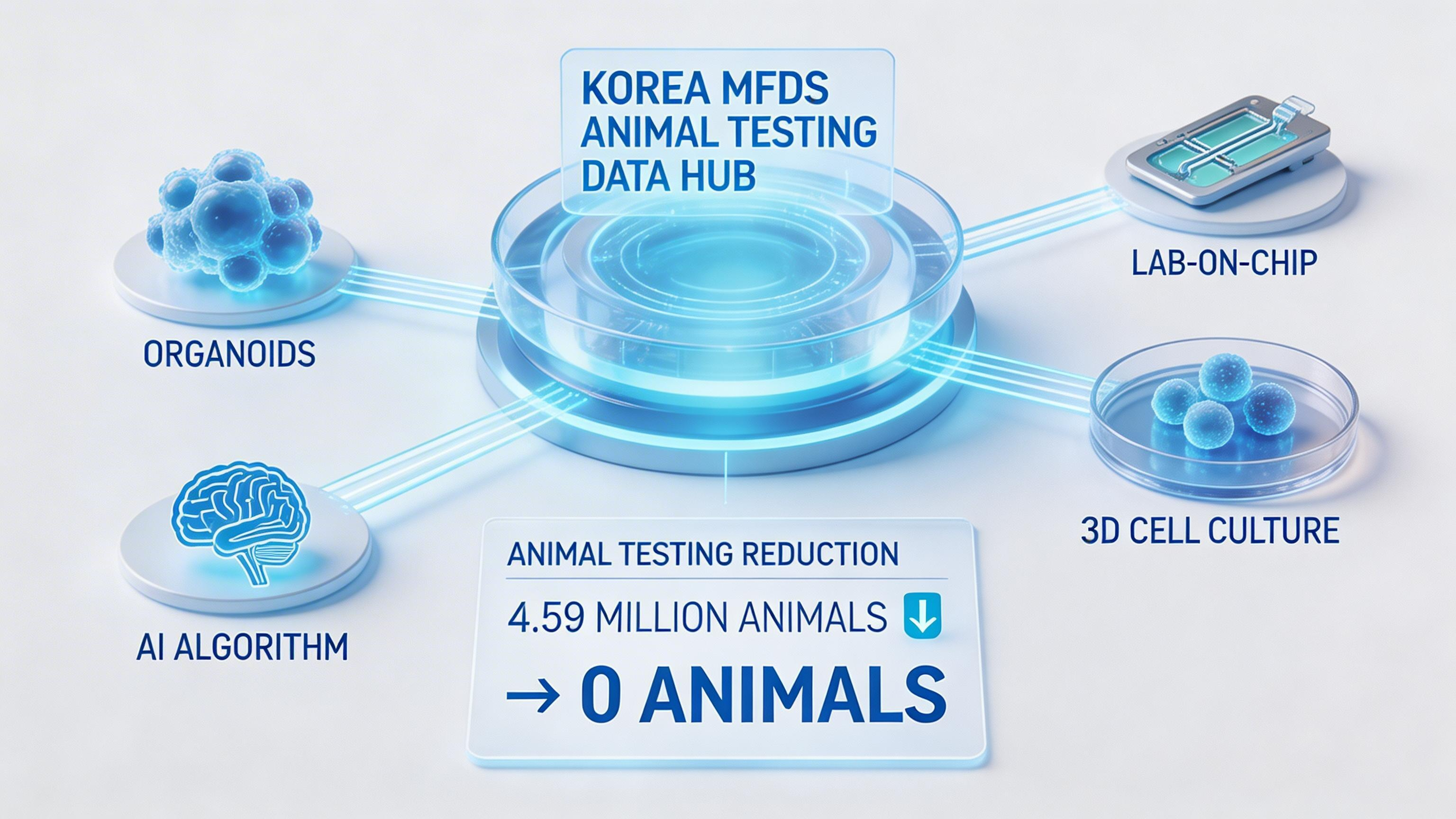
The Ministry of Food and Drug Safety (MFDS) has officially commenced the establishment of a 'Data Hub' for the integrated management of non-clinical test results that replace animal testing. On March 11, 2026, the MFDS officially announced the initiation of a planning research service for the data hub, which will serve as a central axis for the integration, analysis, and utilization of non-clinical test data using advanced animal alternative testing methodologies. The core of this project involves two key objectives. First, to build an integrated platform that allows users to easily search non-clinical test data performed as alternatives to animal testing and intuitively visualize analysis results. Second, to develop machine learning or AI-based algorithms capable of predicting and evaluating the safety and efficacy of cosmetics and medical products based on the collected data. This marks the dawn of an era where AI can predict toxicity and safety without the need for animal testing. This initiative aligns with societal demands. The number of laboratory animals used annually in Korea has nearly doubled in 10 years, from approximately 2.5 million in 2015 to about 4.59 million in 2025. Notably, experiments classified as 'Grade E,' which involve the highest level of suffering for subjects, account for 51.5% of the total, more than five times higher than the European Union's (EU) 9.2%. A 2024 survey by the Ministry of Agriculture, Food and Rural Affairs also revealed that 64.7% of the public believes efforts to replace animal testing are necessary. Previously, relevant ministries, including the MFDS, the Ministry of Agriculture, Food and Rural Affairs, and the Ministry of Climate, Energy and Environment, reached an inter-ministerial agreement in December 2025 to introduce animal alternative testing. The commencement of this data hub construction is a follow-up measure. Considering that the use of laboratory animals has increased despite each ministry beginning to introduce alternative testing methods domestically since 2009, this decision reflects the judgment that a practical transition is impossible without a systematic AI and data-driven infrastructure. This data hub is designed to collect result data from various alternative testing methods, such as organoid and cell-based 3D culture models, Organ-on-a-Chip, and computer simulations, for AI learning and prediction. In the long term, it is expected that a system for AI-based screening of toxicity and efficacy without animal testing will be established from the early stages of new drug development. Global regulatory trends are also moving in the same direction; the EU has already completely banned animal testing in the cosmetics sector, and the FDA is also shifting its policies to reduce reliance on animal testing.