

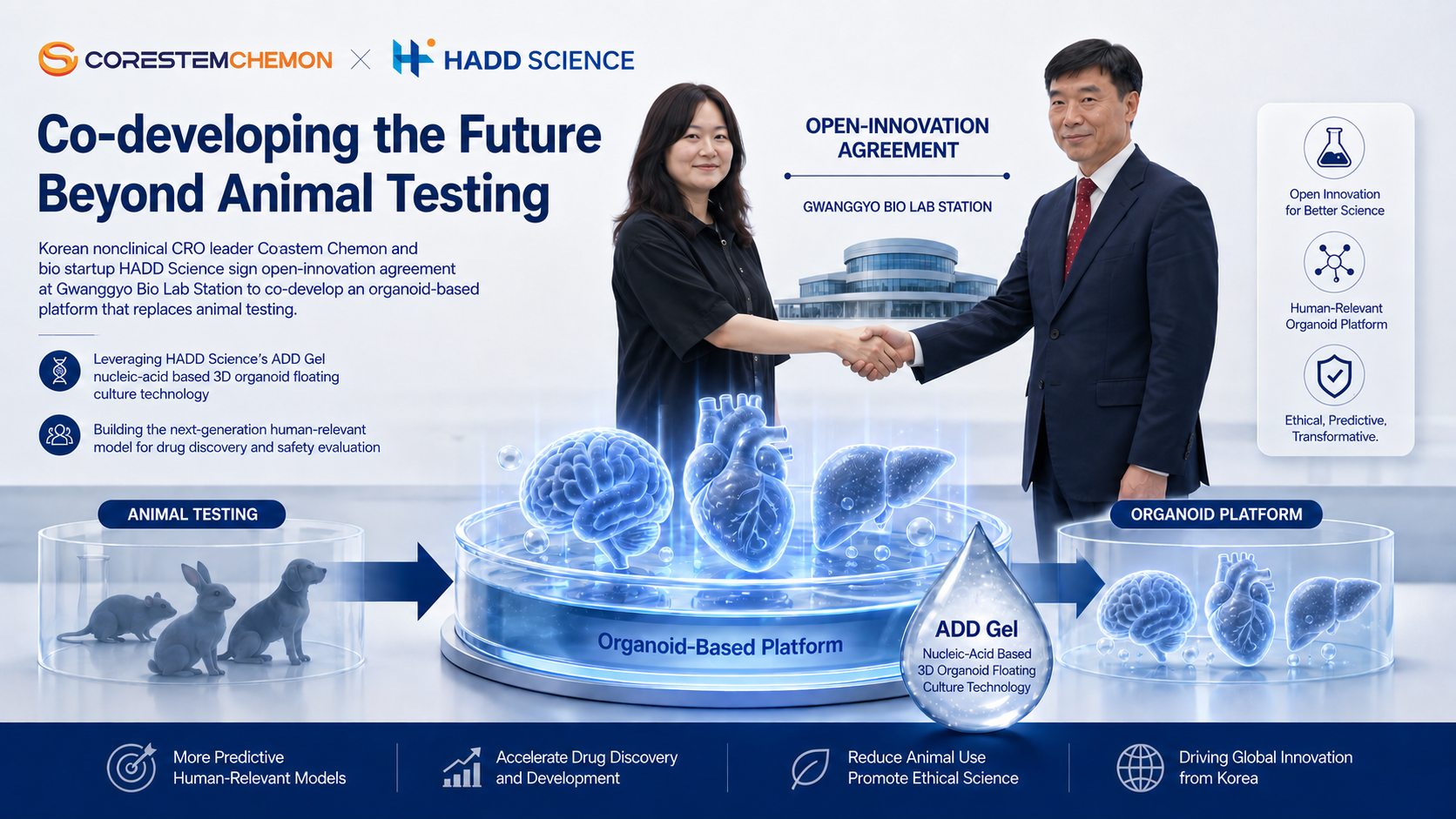
Non-clinical CRO CoaStemChemOn and biotech startup HADD Science signed a joint research and development agreement on June 4 to 'establish a future organoid platform'. This collaboration is precisely aimed at the rapidly growing global market for 'New Approach Methodologies (NAMs)' for animal alternative testing. The two companies have agreed to jointly pursue the development and commercialization of a CRO evaluation platform based on 3D organoid culture technology. CoaStemChemOn will be responsible for cell safety-focused culture technology and evaluation infrastructure, while HADD Science will contribute its nucleic acid-based 3D organoid floating culture technology, ADDGEL. The key advantage of ADDGEL is its ability to induce long-term stem cell differentiation in large-scale cultures, possessing both biocompatibility and product uniformity. The true significance of this agreement lies in its 'market timing'. The FDA has officially begun to adopt NAMs to replace animal testing in some Phase 1 clinical trials, and the EU is gradually strengthening the mandatory use of animal alternative testing in cosmetics and pharmaceuticals. For multinational big pharma companies, an evaluation model that 'resembles the human body' has become a critical factor determining the speed and cost of new drug development. The two companies envision commercializing services for new drug efficacy/toxicity evaluation and disease model evaluation by mass-culturing various organoids, including brain, heart, and liver organoids. Yang Gil-an, CEO of CoaStemChemOn, stated, “This will also help strengthen competitiveness in new drug and cell therapy development.” Heo Chae-jeong, CEO of HADD Science, emphasized, “Open innovation with a top-tier non-clinical CRO will allow us to expand our organoid, 3D cell culture, and mini-organ culture platform technologies more rapidly.” Delving deeper, this agreement serves as an exemplary case of the K-bio open innovation model, connecting 'government → cluster → companies'. Both companies are based at the 'Gwanggyo Bio Lab Station' and Gwanggyo Bio Center, operated by the Gyeonggi Economic & Science Institute, and the collaboration naturally materialized within the cluster. When viewed in conjunction with the 'Bio Mega Special Zone Menu-Based Regulatory Exemptions' announced by the Ministry of Health and Welfare on June 1, the allowance of decentralized clinical trials, and the expansion of advanced regenerative medicine application scope, Korea has entered a phase where 'regulations, facilities, platforms, and CROs' are all aligning. In essence, this CoaStemChemOn–HADD Science agreement is not merely an MoU between companies, but rather the first 'hardware + software' integration case for Korea to truly enter the global animal alternative testing platform market as a competitor.