

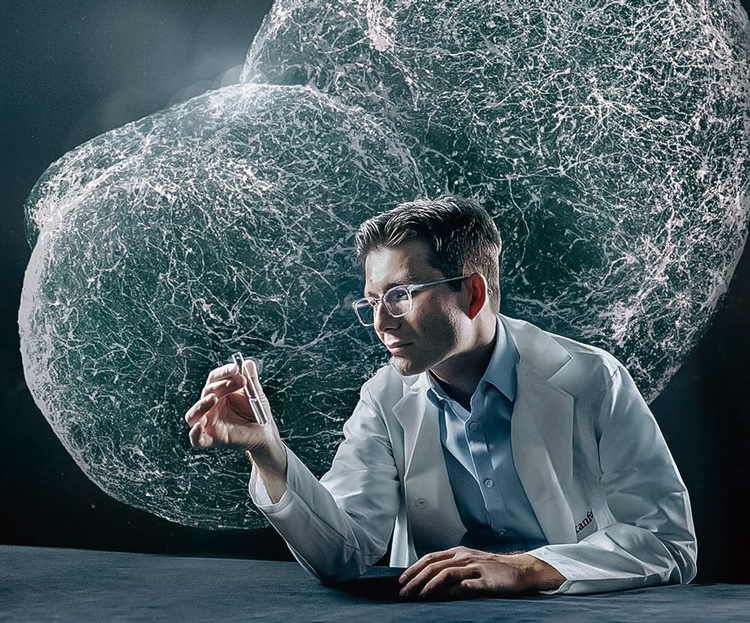
The background features a mini-brain. Professor Pasca successfully implanted a human mini-brain into a mouse brain, integrating them. (Photo courtesy of Stanford University, U.S.) Professor Sergiu Pasca's team at Stanford University School of Medicine in the U.S. announced in Nature their successful development of an 'assembloid' that fully replicates the human pain transmission pathway. Dr. Ji-il Kim, a Korean researcher, garnered attention for his participation as a co-first author in this study. The research team utilized induced pluripotent stem cells to create a 1.25 cm long, assembled mini-organ that embodies the pain pathway, extending from skin sensory nerves to the spinal cord, thalamus, and cerebral cortex. This assembloid, comprising 4 million interconnected neurons, demonstrated the same pain signal transmission process as actual humans in capsaicin injection experiments. Notably, it successfully validated sodium ion channel mutations, a major cause of chronic pain, within the organoid, paving a new path for therapeutic development. While most existing pain relievers are repurposed psychiatric drugs or sleep disorder treatments, leading to side effects and addiction issues, this breakthrough now enables the development of human-applicable treatments without the need for animal testing. Chronic pain, classified as a disease by the WHO in 2018, is a common condition affecting 1 in 13 people worldwide, yet effective treatments have been lacking. This technology is also expected to be utilized in research on neurodevelopmental disorders such as autism spectrum disorder. The U.S. Advanced Research Projects Agency for Health (ARPA-H) has decided to invest a substantial 153.4 billion KRW (approximately 110 million USD) in developing treatments for related brain diseases. Professor Pasca previously succeeded in implanting human brain organoids into mouse brains in 2022, indicating a high potential for future development into treatments for neurodegenerative brain diseases like dementia.