

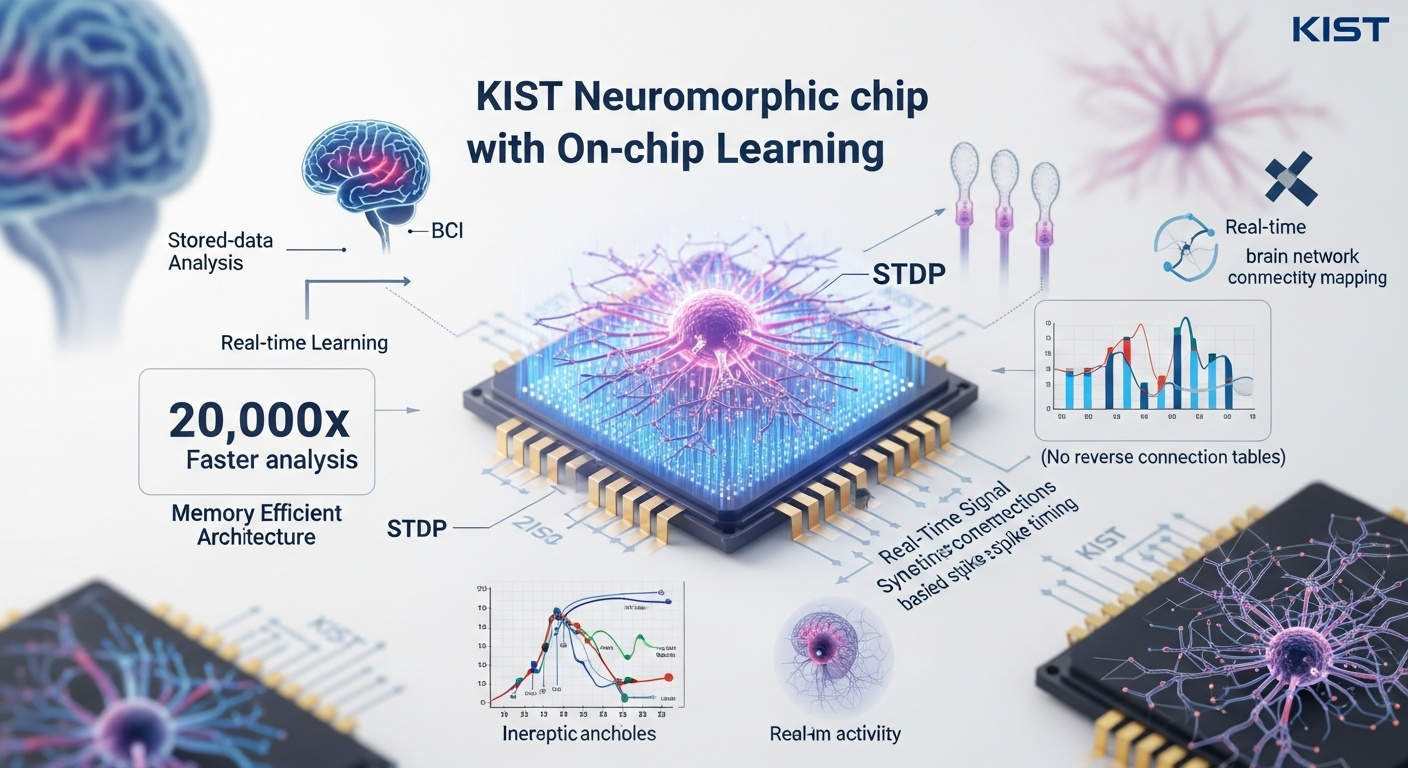
A research team led by Dr. Jong-gil Park of the Semiconductor Technology Research Group at KIST has developed an 'on-chip learning-based neuromorphic system' that directly implements the brain's learning principles into a semiconductor chip, enabling real-time analysis of neural network connection structures 20,000 times faster than existing methods. This technology could become a core foundation for brain-computer interfaces (BCI) and is expected to accelerate the realization of next-generation technologies such as controlling artificial limbs with thought alone or enhancing human intelligence. The research team engineered the 'Spike-Timing-Dependent Plasticity (STDP)' principle, where the brain adjusts connection strengths based on the order of signal generation between neurons. Previous technologies involved storing neural activity data for extended periods and then calculating connection relationships using statistical methods. This approach led to enormous computational loads and time delays as neural network scales grew, making real-time analysis impossible. The KIST researchers eliminated the memory-intensive 'reverse connection table' and devised a new learning structure, implementing scalable STDP even in highly integrated neuromorphic hardware. As a result, they achieved processing speeds up to 20,000 times faster while maintaining similar interpretation accuracy. Neuromorphic technology is a strategic field in which major developed countries like the United States and Europe are heavily investing to secure technological hegemony. However, it has faced commercialization challenges due to a lack of specific applications (killer applications). The KIST research team's 'real-time brain neural network connection structure analysis' technology is a case that demonstrates the practical applicability of neuromorphic technology and is considered a turning point for the commercialization of next-generation AI semiconductors. Dr. Jong-gil Park stated, "Its simple hardware structure and easy scalability mean it can be applied not only to controlling devices with thought alone or replicating specific brain functions but also to advanced AI fields such as autonomous vehicles and satellite communications."