

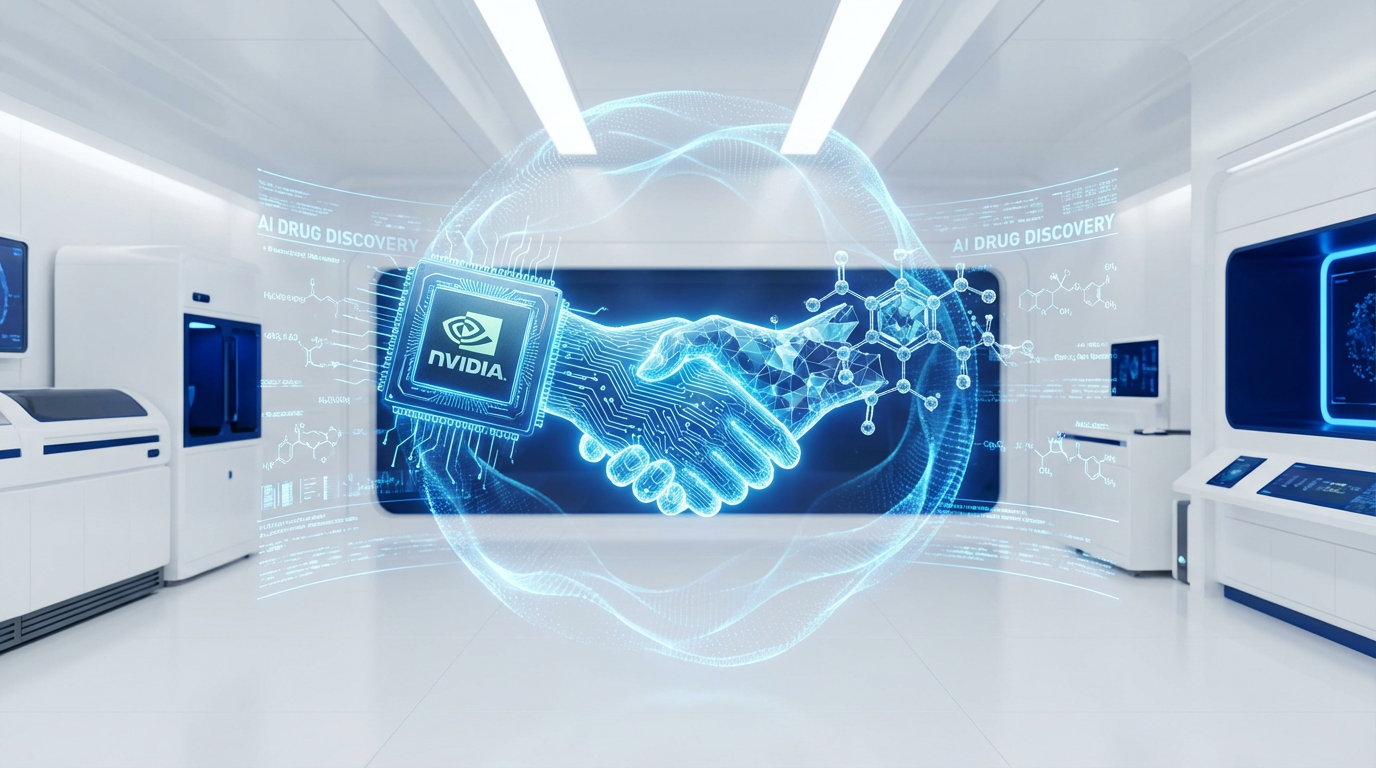
NVIDIA, the leading semiconductor company, and Eli Lilly, the world's top pharmaceutical company by market capitalization, have joined forces. The two companies announced a joint investment of up to $1 billion (approximately KRW 1.4 trillion) over the next five years to establish a collaborative AI-driven drug discovery research institute. This collaboration is regarded as more than a simple technological alliance; it is a fundamental attempt to transform the paradigm of the pharmaceutical industry. NVIDIA will combine its GPU-based AI computing platform and generative AI technology with Lilly's extensive clinical data and drug development expertise to innovate the entire process, from drug candidate discovery to clinical trial design and manufacturing process optimization, using AI. Kimberly Powell, Vice President of Healthcare at NVIDIA, emphasized, "AI will exponentially accelerate the pace of biological discovery," and stated, "Our collaboration with Lilly will present an entirely new blueprint for drug development." David Ricks, CEO of Eli Lilly, also declared, "AI is now an essential infrastructure for the pharmaceutical industry," adding, "This alliance will be a groundbreaking turning point in the development of treatments for intractable diseases." Key aspects of the collaboration include the $1 billion joint investment to operate the AI drug discovery research institute for the next five years, applying AI comprehensively from candidate substance exploration to clinical trial design and manufacturing process optimization. Furthermore, they will build a life science data analysis platform utilizing open-source AI models, and NVIDIA has also entered into a long-term partnership with medical AI company Tempus AI. JPM 2026 is the industry's largest event, attended by over 8,000 investors and more than 500 pharmaceutical and biotech companies worldwide. This year, AI, digital healthcare, and obesity treatments emerged as major topics. Key Korean companies such as Samsung Biologics, Celltrion, and Samjin Pharmaceutical are participating to explore global partnership opportunities. Traditionally, new drug development has been a high-risk endeavor, requiring 10-15 years and trillions of won in costs. However, the common industry outlook is that AI can shorten this process by more than half and reduce costs by 20-30%. Vice President Kimberly Powell described this as the "iPhone moment" for the pharmaceutical industry. There are three main implications of this collaboration. First, as NVIDIA's entry into healthcare becomes full-fledged, competition for leadership in the bio-AI ecosystem will intensify. Second, as big pharma accelerates AI investments, traditional drug development models will be reshaped. Third, Korean bio companies also need to seek AI partnerships; otherwise, a technological gap is a concern. 🔗 Source: